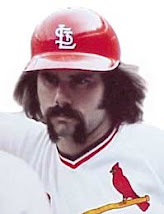
First of all, they should have never been described as “baseball trading cards.” They were, and always will be, baseball cards. For a youngster, baseball cards were the greatest. There has probably never been anything more useful and more fun on the planet. A young boy could do anything with those cards: connect to his favorite team, learn baseball history and trivia, invent games for starters. Personally, I attribute my excellent alphabetizing skills to spending hours organizing and reorganizing my baseball cards. Some baseball cards made a boy smile or even laugh. And some cards, when washed with your favorite jeans or stolen by a “friend,” brought a boy to tears. Nothing on earth can summon emotion like a few minutes revisiting your baseball card vault, usually a reclaimed, crudely decorated shoebox.
Going through that shoebox takes me back three decades, and nothing says late seventies like the smell and sight of baseball card gum. The gum was pink like other bubble gum, but flat, thin and rigid like a miniature diving board. The newness of the package of baseball cards could be calculated by inspecting the gum. It was a boy’s version of carbon dating, only more precise. If the gum was still a little soft, the cards were hot off the press. If the gum was brittle, the cards had been sitting in a storeroom for months. All card collectors fondly keep the scent of the gum mixed with the cardboard in their memory. If they ever make Old Spice with that fragrance, I would buy it.
The funny thing about the gum is that back then you complained about it. The gum was a lot like the kid nobody liked at the neighborhood pool. When he was the only kid at the pool you were glad he was there, but otherwise he was an outsider. Likewise, if you had a piece of sour apple bubble gum in your mouth, that flat gum with the mysterious white powder coating probably got put in the sock drawer or thrown away. However, if you hadn’t had a piece of gum in a couple days, that flat, brittle gum wasn’t so bad after all. One of the greatest baseball cards ever is the Topps brand Oscar Gamble “Traded” card from 1976. That thing was legendary on the shag carpeted floors of living rooms and bedrooms across America. Oscar Gamble was a quality journeyman outfielder in the American League, but this didn’t make his card famous. He was famous for his picture on the card. When a kid saw the card, he immediately discovered two things. His silhouette matched that of the most famous clown of the era, Bozo. Gamble had the most magnificent, voluminous afro ever photographed. His baseball cap precariously held the top of the ‘fro temporarily at bay. In our neighborhood, well before the invention of political correctness and to young to be prejudiced, we called Gamble, “Black Bozo.” As a kid began to really study the card, another discovery unfolded. The bluish and blackish colors were phony-looking. The trademark New York Yankee logo and pinstripes were actually painted on Oscar, by some artist. Since he was traded, Topps had to use a picture of him in his old Cleveland Indians uniform. What a revelation for a kid! When I figured all this out, I felt like I had discovered something big and important, like Mom discovering Fresca.
 In the late seventies, even kids knew the American economy was weak. How could you not know? Walter Cronkite reminded you every time you walked through the living room between 7 o’clock and 7:30. Pictures of the people in California waiting in long lines for gasoline kept popping up behind him in the corner or the TV screen. Maybe watching CBS Evening News, and maybe in an effort to rationalize and modernize things; my brother suggested we throw out all of our old cards. Something about saving space for new cards. Sometimes younger brothers can think for themselves. Did I ask why we weren’t throwing away old Hot Wheels? No. This was one of those times the younger brother couldn’t think for himself. I don’t know how many cards were rationalized, probably not many because I was only six, but it still makes me wonder if I carelessly threw away a Hank Aaron or George Brett. Damn it.
Kids and parents weren’t limited to buying the Topps cards at the 7-11 or Majik Market. You could also find baseball cards in areas of the grocery store. Kellogg’s had “3-D” cards in some cereal boxes, probably Frosted Flakes. These cards were a little smaller than the regular size and had some late seventies not-quite-three-dimensional quality to them. The Frosted Flake boxes at our house always produced the Kansa City Royals pitcher, Steve Busby. I never figured out how some guy named Steve Busby always ended up on the kitchen table with half a box of cereal every summer Sunday morning. Hostess or some other snack cake company also had their own version of baseball cards. These were the pits. First, they printed the card on the back of the boxes. No surprise, no anticipation. All you could do is yell at your mom for not selecting the right box while she was at the store. Why couldn’t she find the box with the Jim Rice card? Second, somehow the card had to be removed from the box. This meant a seven year old would try to cut out the cards perfectly. The outcome would have been better, safer and less frustrating, if I had just handed the crappy, rounded-edge scissors to Ray Charles. These cards, ultimately an insignificant speck in the Topps dominated world of baseball cards, were worse than the pits, way worse.

Baseball cards began to lose their innocence when the guys in the corner offices at Topps started marketing complete sets of cards. Who knows when Topp’s started doing this, it seemed like it may have been at exactly the same time I saw a copy of “Baseball Digest” (This was not in the barbershop. Males in our house didn’t go to the barber unless they could pay for a haircut. Until you could mow a lawn, Mom mowed your with the clippers). As you leafed through the tiny pages of “Baseball Digest,” you figured out that the Spoiled Rich Kid could buy the entire yearly set of every possible card at once. This meant that the Spoiled Rich Kid would not have to suffer through duplicates and triplicates of guys like Darrell Chaney and Mike Lum. Instead, the Spoiled Rich Kid was guaranteed a Reggie Jackson, Johnny Bench, Catfish Hunter, Dale Murphy, etcetera without all the hassle. One year for my birthday, my dad got me a subscription to “Baseball Digest” for my birthday. I loved to read that little magazine, but the baseball card ads always reminded me of the faceless, but evil, Spoiled Rich Kid.
Luckily, there was a suitable alternative to complete sets of baseball cards: the multi-packs. Suddenly you, or more likely your mom, could buy something like nine packs of cards at once. No matter how poor a child’s math skills, he could easily explain to Mom that it much more was more economical to purchase cards that way. (I guess these cards even taught me economics). Multi-packs were like a mini-Christmas. You got nine presents, not just one. When you started unwrapping the cellophane and smelling the gum and cardboard mixed together, anticipation was high. I just knew I was about to get a Johnny Bench or Reggie Jackson in the multi-pack. Duplicates and triplicates were frequent but much less annoying. Heck, you didn’t complain at Christmas, when one of your gifts you unwrapped was always a couple pairs of socks.
The marketing geniuses did more than just cater to bourgeois card collector who probably got his hair cut by a real barber. These guys messed up the beautiful, simplistic pastime. They began competing with each other and flooded the market with products. In the good old days, I could grab a pack of Topps cards by the gas register at the gas station, the ball field concession stand or at a K-mart. All of the sudden, I had to navigate an aisle with Topps, Donruss, Fleer and Upper Deck, not to mention football, basketball and hockey cards. Sometimes the aisle grew to include Star Wars and Battlestar Gallactica cards. Collecting baseball cards was getting complicated. Sooner or later, a buyer ventured outside the genre. This was always a disaster. The football cards were confusing because there were so many nameless, faceless linemen, back-ups and back-up faceless linemen. And, Star Wars was a movie after all. It was the world’s greatest movie to a seventies kid, but it was a movie. Now, you’ve wasted your baseball card money on the other crappy cards. The cards may have been labeled Return of the Jedi, but they were actually the return of the pits.
No matter how hard the card companies efforted, they could not compete with puberty. Baseball cards don’t captivate the teenager. Young boys liked to look at the pictures of smiling, fit men. Teenage boys are more interested in pictures of smiling, fit females. Like someone had flipped the switch on the Atari, it was “Game Over.”
 More than a few years later, I’m back in the card aisle, again. The card aisle is now in the Target, across street from the old K-Mart. There are still Star Wars cards, but I’m told they are now called Clone Wars, or Star Wars/Clone Wars or something. I can also choose Sponge Bob cards or Jonas Brothers cards. The full-sets for the Spoiled Rich Kid are in the aisle too. Then, the baseball card area pulls me over with its own tractor beam. On the bottom of the shelf, on the right, sits a few plastic cubes holding 200 cards each, even more than the old multi-packs! I pick one up. Dale Murphy, our hometown hero, flashes his boyish, naive grin up at me. Inside the cube is a mix of “surplus cards.” Some of them are new and some must be at least twenty years old. This is a cool find, very cool. At the ball field, I give these cards out to the players on my youth baseball team of 4, 5 and 6 year olds. The boys instantly love their first cards. They’re hooked. It doesn’t matter that most of the young boys can’t read the names on the cards, and they certainly can’t recognize the faces. The boys’ fathers remember the names and faces.
 Please share your favorite, or least favorite, baseball card memory by posting to a comment.
 When The Most Interesting Man in the World imported “eight models” into a French ski resort called Courchevel and was arrested … The French police later apologized.
 The Most Interesting Man in the World is Russian uber-magnate Mikhail Prokhorov. Last week he bought the 80 % of the NBA’s New Jersey (soon to be Brooklyn) Nets. Prokhorov is one of the two most successful Pioneers in Russia’s transition into capitalism and the free market. His estimated wealth is between $13-18 million. How did he get his start? He created a business selling stone washed jeans. How great is that? He helped usher capitalism and stone washed jeans into the former U.S.S.R. Through various successes, “loans,” “auctions” and seemingly nefarious power deals, he has accumulated ridiculous wealth well in advance of his 45 th birthday. On his rise to ridiculous wealth Prokhorov said, "I do not want to reveal all my secrets.''
 The Most Interesting Man in the World is Russian uber-magnate Mikhail Prokhorov. Last week he bought the 80 % of the NBA’s New Jersey (soon to be Brooklyn) Nets. Prokhorov is one of the two most successful Pioneers in Russia’s transition into capitalism and the free market. His estimated wealth is between $13-18 million. How did he get his start? He created a business selling stone washed jeans. How great is that? He helped usher capitalism and stone washed jeans into the former U.S.S.R. Through various successes, “loans,” “auctions” and seemingly nefarious power deals, he has accumulated ridiculous wealth well in advance of his 45 th birthday. On his rise to ridiculous wealth Prokhorov said, "I do not want to reveal all my secrets.''


 Posts
Posts